
CCTV survey: $300–$750
Stands alone and is credited against the works by most operators. Without it nobody can price a liner honestly.
Relining turns a recurring drainage problem into a finished one. The joints that roots come through are sealed along the whole run, so there is no way back in, and nothing above the pipe gets disturbed to do it.
A resin-saturated liner is drawn into the existing pipe through an access point, inflated so it presses against the wall, and cured until it hardens. What you are left with is a continuous pipe inside the old one, with no joints along its length and a slightly smaller bore than the original.
Nothing is excavated, and the cured surface is smoother than the clay or concrete it lines, so flow is typically maintained or improved despite the small loss of diameter. On a property where a driveway, mature garden or paving sits over the line, that is the whole argument.
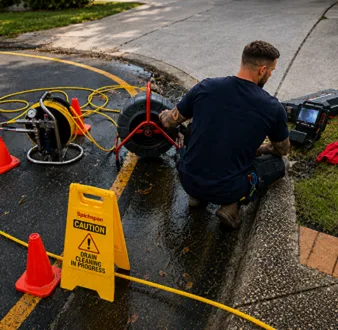

An older house is rarely on one generation of drainage. It is on three or four, joined wherever a bathroom moved or an extension went on, and the transitions between materials are where most faults sit.
A camera run on a property like this is genuinely diagnostic rather than a formality. It is common to find a sound original clay run, a poor 1970s junction, and a modern PVC section all on the same line, each needing a different answer.
Where the water table sits close to the pipe, every open joint is an entry point. The line runs fuller than it should year-round, silt comes in with the water, and the system behaves as though it is undersized when it is simply leaking inward.
The peninsula’s sandy soils flow into any crack or open joint in older clay drains, silting lines up from the inside until they block.
Sealing the run changes that immediately, and it is one of the clearest before-and-after results relining produces. It is also the case most often missed, because nothing looks broken from the surface.
On a clay line the barrel is usually fine. What has gone is the mortar or rubber ring at each joint, and there is one every few hundred millimetres, which is a great many small openings after sixty or eighty years in the ground.
Many of the suburb’s bungalows still use original earthenware sewers approaching a century old, with worn joints that snag paper and waste.
That matters for the quote. You are not replacing a pipe, you are sealing a long series of joints, and a liner does the whole run at once rather than patching them one at a time.
Root intrusion is not automatically a relining job. If the roots are fine and the pipe behind them is sound, a cut and jet with a maintenance interval can be the right call for years.
What moves it to relining is structural: an open joint you can see daylight through, a cracked barrel, or a run that has been cleared repeatedly at shortening intervals. Anyone quoting a liner without showing you the inside of the pipe is guessing, and you should ask for the footage.
A listing does not stop you repairing a drain. What it restricts is change that is visible or that disturbs significant fabric, which is precisely what a trenchless repair avoids.
In practice that makes relining the path of least resistance on a listed or conservation-area property: nothing is removed, nothing changes above ground, and there is no reinstatement to get approved.
Excavation close to the foreshore brings problems that have nothing to do with plumbing: unstable saturated ground, dewatering, restricted access down a narrow lot, and reinstatement of landscaping that was not cheap to build.
The trenchless comparison is not repair against repair. It is repair against repair plus everything sitting on top, and on a waterfront block that second half is usually the bigger number.
Stands alone and is credited against the works by most operators. Without it nobody can price a liner honestly.
The usual Sydney range for domestic sewer. Access and junction reinstatement are normally quoted separately.
One defect in an otherwise sound run. The proportionate answer on stable ground, and the wrong answer on a line with twenty tired joints.
Where the camera shows the same failure repeating along the length. Ends the problem rather than relocating it.
The honest comparison. Cheaper on an open lawn, rarely cheaper under a driveway, paving or a building.
These are market ranges, not our price. Nothing is quoted before the survey, and nothing starts before you agree it. Figures here are indicative of the 2026 Sydney market rather than a quote from us, you get your own number as a fixed price before any work starts.

A CCTV survey establishes the material, the diameter, where the defects are and how far they sit from the access. You see the footage, and it is what the quote is built from.
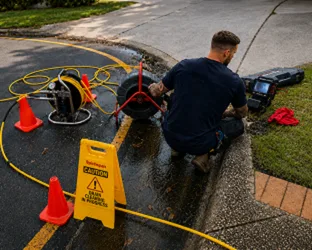
Patch or full length, and occasionally excavation instead. We will tell you when digging is the better answer even though it is the bigger quote.
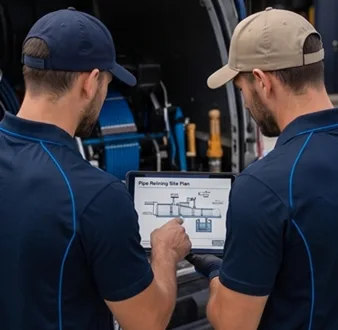
The run is jetted so the liner bonds to pipe rather than debris, the liner is installed through the existing access, and it cures in place. Most domestic jobs are a single day.

Every branch the liner passed is reopened from inside, then the run is cameraed again so you can see it is continuous and the junctions are clear.
Leave your details and a licensed plumber will call back to arrange the survey. No quote is given before someone has seen inside the pipe.
Straight answers on price, durability and when to dig instead.

Call for the fastest answer, or send the form and we will arrange a camera survey before anything is quoted.

Leave your details and our local Sandringham team will call you back fast.